Granite, marble or slate for a Vermont plot? What forty winters do to each
How Barre grey, imported granite colors, nineteenth century marble and roofing slate each hold an inscription through frost, road salt and months under snow.
Who signs off on your headstone before the carver starts cutting?
In small New England burial grounds, the plot record and a trustee's written permission decide the stone's size, material and fittings long before a carver quotes the work.
Settling the wording before the stone goes to the shop, and what a careful reader checks
Names, dates, nicknames and an epitaph are fixed the moment the blast hose starts, so here is what to verify while changes are still free.
Pricing a stone in a small Vermont cemetery, and which line items you can actually move
A memorial quote is five or six separate purchases printed as one number, and only some of them are open to negotiation.
Walk any hill cemetery in Vermont or western New Hampshire in late April, when the snow has pulled back but the grass has not started, and the material history of the place is laid out in order. The marble is oldest and hardest to read, the slate is often older still and perfectly legible, and the granite is newest and looks almost unchanged. That ordering is not an accident of care or neglect. It is chemistry, grain size and water, working on three very different stones across the same forty or hundred and forty winters, and it is the single best evidence a family has when choosing what to buy.
What frost, salt and snow cover actually do
The damaging cycle is not cold. It is water that enters the stone, freezes, expands, and does so repeatedly, which in a New England shoulder season can mean dozens of transitions in a single month rather than one long freeze. A stone with fine, tight grain and low porosity takes on little water and loses little material. Snow cover, counterintuitively, protects: a monument buried from December to March sits at a stable temperature and skips the worst thaw cycling. The stones that suffer are the ones exposed on wind-scoured knolls, and the ones near a road where plow spray carries chloride onto the base each winter.
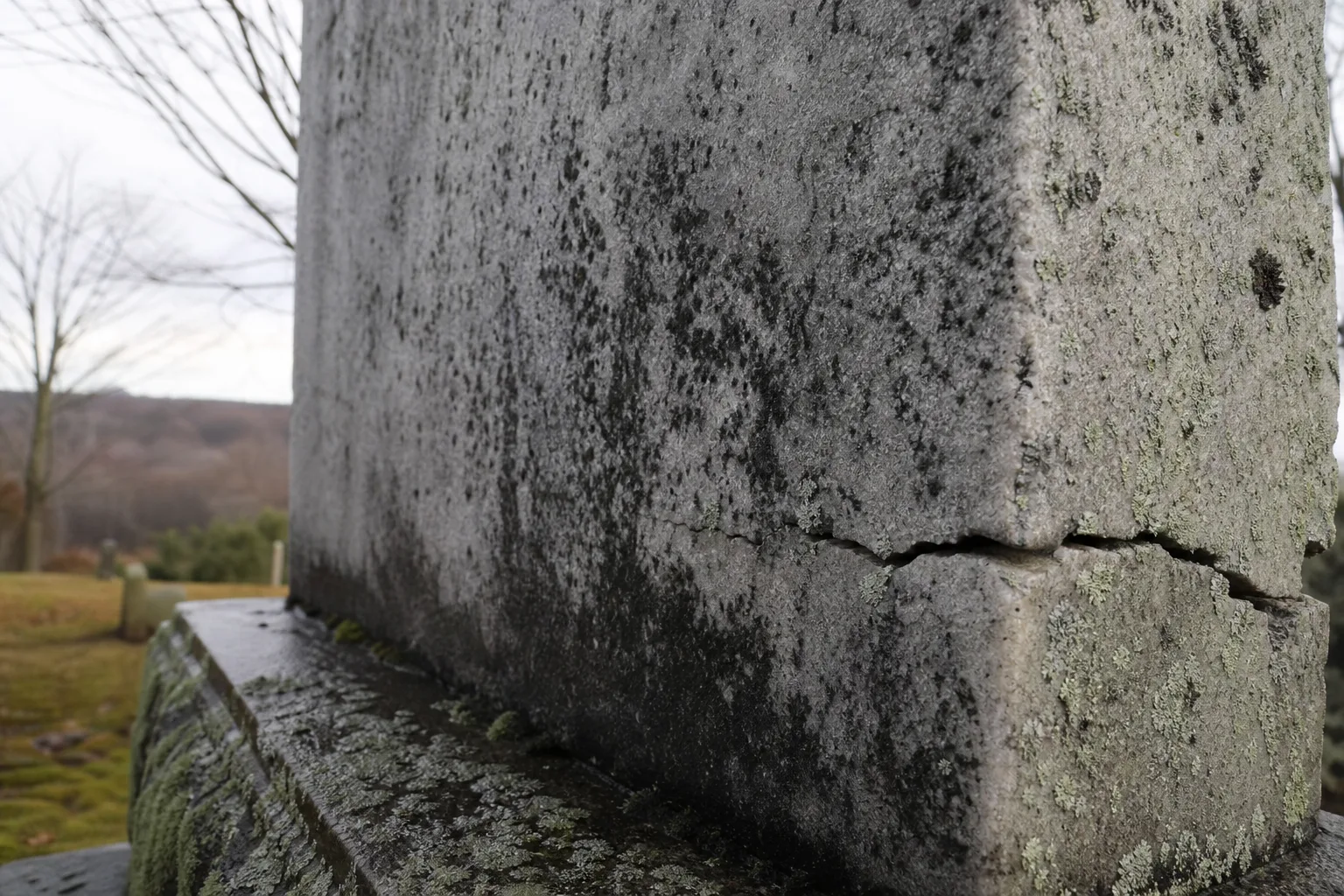
Road salt matters most at the bottom eighteen inches. Chloride-laden meltwater wicks up into a porous base, crystallizes as it dries, and pushes the surface off in flakes. A careful reader checks the bottom of nearby stones before choosing anything, because that band tells you what the site does to material over decades. If the older bases within thirty feet of the drive are spalling and the ones set back are clean, the sexton's placement decision has just become a materials decision too.
Granite, and why Barre grey became the default
Barre grey is a medium-grain granite quarried in central Vermont, and its reputation rests on being predictable rather than dramatic. It takes a clean sandblasted or etched inscription, holds a polished face without clouding, and weathers slowly and evenly, which means the stone your grandchildren see will look like the stone you paid for. Imported colors, the reds and blacks and mottled browns from India, China, South Africa and Brazil, are genuinely durable stones, and the objection to them is rarely performance. It is that dark polished surfaces show mineral deposits and water staining more visibly in a wet climate, and that a lettered inscription on black granite reads by contrast of polish, which fades as the polish weathers.
A careful reader asks the carver two things: the grain, and how the letters are finished. A frosted or lithichrome-filled letter on grey granite stays readable for generations with no attention at all. A polished-face letter on black relies on a surface treatment that will need renewal, which is a maintenance commitment nobody mentions at the point of sale unless asked.
Marble going sugary, and slate's quiet advantage
Nineteenth century marble monuments in this region are calcite, and calcite dissolves in mildly acidic rainfall. The Environmental Protection Agency is responsible for monitoring acid deposition nationally, and the mechanism it tracks is exactly what has erased so many 1840s inscriptions: the surface loses its cohesion, the crystal boundaries open, and the stone takes on the granular texture people describe as sugaring. Once that starts, cleaning accelerates it. A marble stone that has gone sugary should be left alone, photographed, and documented, not scrubbed.
Slate is the surprise. Split roofing-grade slate from the Vermont and New York belt is dense, nearly non-absorbent, and cleaves in flat sheets, so eighteenth century slate markers frequently carry crisper lettering than marble installed a century later. Its failures are mechanical rather than chemical: delamination along the bedding plane, and breakage from mowers or frost heave, both of which are addressable with proper setting depth and a clear ground-maintenance understanding with the trustees.
What the family is signing up for
Lichen is the ongoing item on every material. It is slow, it is largely cosmetic on granite and slate, and the accepted treatment is a non-ionic cleaner and soft brushing at intervals of several years, never a wire brush or a pressure washer. Granite asks for almost nothing. Slate asks for attention to its footing. Marble, if chosen new today, asks for the acceptance that it will soften.
Ask the sexton which stones on the grounds have needed resetting, and why. That answer, more than any brochure, tells you what your site will do to your choice.
- Freeze-thaw count, not cold
- Damage comes from repeated water entry and freezing, not from low temperature alone. A New England spring can cycle a stone through freezing dozens of times in a single month.
- Snow as insulation
- A monument buried under snow from December to March sits at a stable temperature and skips the worst thaw cycling. Wind-scoured, exposed sites see far more damage than sheltered ones.
- The bottom eighteen inches
- Plow spray carries chloride onto the lowest band of any stone near a drive. Salt crystallizing inside a porous base is what pushes the surface off in flakes.